I've been quite prolific over the past few weeks. Last weekend was a bit of a two-faced affair, with a gorgeous Saturday (which made me go out and waste a roll of Delta 400 - results slightly meh), followed by a Sunday with incessant rain. This gave me the opportunity to finally build my little macro studio which mostly consists of a box of cardboard with the two sides cut out and the gaping holes covered with tracing paper as a diffuser. Softly bent white poster board serves as the seamless backdrop. These things have been done and written about to death so there is no point in further going into great details here. Find DIY instructions on the internet, for example
here.
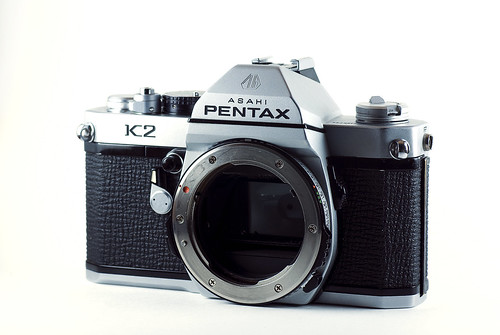
Now, while a setup like this gives you pretty well controlled and soft lighting, it's still not quite as straight-forward in practice as the idea is to eliminate all shadows and get an almost pure white as the backdrop for the object. This shows what I mean:
This I shot digitally and while this gives you an infinite amount of retries, even then you will have to battle with slight unevenness in the lighting, Look at the upper-left corner. This is not lens-vignetting but rather a slight darkening caused by lack of light. So the diffusion is not perfect. Also, take note that this is not what it looks like straight out of the camera. It requires post-processing to make the whites as white as it is and, in particular, to fix the white-balance which always has the tendency to be off. Both the camera and Photoshop will distrust all the white in the frame, resulting in an amber tone.
Using film for shots like this requires a different strategy: First off, you don't get to re-shoot until it's right and you wont get any kind of feedback until the film emerges from the development tank. On the plus-side, it's easier to obtain pure white as bumping the development time will leave the shadows largely intact but bump the highlights. Finally, film (especially B&W) is much more robust as far as white-balance is concerned.
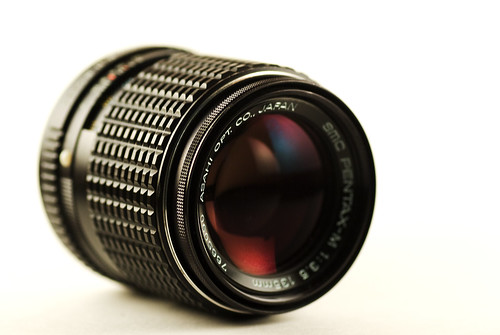
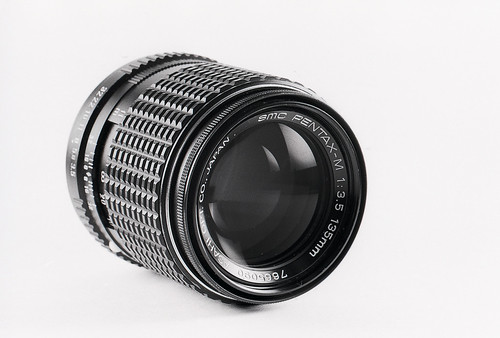
And now behold the following two shots: Identical setup (well, close to; ignore the slightly different angle and relative size of the object), the same lens (Tamron 90mm f/2.8) but different cameras (Pentax K10D versus Pentax K2) but most importantly, one shot digitally and the other shot on film:
The digital one offers color which is nice as it literally makes the coating of the lens visible. The depth-of-field is too low. I was impatient and wanted to try out the just completed macro studio right away, hence I shot hand-held. At ISO 400, I needed f/4.5 to obtain a barely hand-holdable shutter speed of 1/60. The white-balance is slightly too warm, too.
For the second shot, the camera rested firmly on a tripod and this time I used a much smaller aperture (either f/11 or f/16) at a shutter speed of one or two seconds. The film is Efke 25KB. Film of such slow speed is really an anachronism but it's paying huge dividends here. This is almost medium-format territory as far as sharpness and details are concerned. Noise is low but this being B&W film, it is of course still discernible. Find larger-sized versions of this shot
here.
What is most striking however is the appearance of a much sharper contrast even though a histogram would disagree and indicate that the above digital shot has in fact darker shadows and brighter highlights.
For those keeping book, I developed the roll of film in Ilford Ilfosol-3 (diluted 1+19) for 7 minutes at 20/68 degrees. Ilfosol is said to be a good developer for slow film and I would agree. The little bit of additional grain it induces is a low price to pay for the higher accutance and local contrast it delivers.